
Active Warrants in Baltimore City
Warrants in Baltimore City are issued by judges and District Court commissioners. A judge may issue a bench warrant when someone fails to appear or breaks a court order. A commissioner or judge may issue an arrest warrant on probable cause. No official public active-warrant search portal for Baltimore City was found. That is the key fact. Unlike some counties, the city does not post a live list of open warrants for anyone to browse.
So how do warrants surface? Some show up indirectly. A warrant event can appear in a case docket on Case Search after the warrant is served or recalled. Bench warrants may show as docket history depending on case status and access rules. Unserved arrest warrants do not appear there. They are restricted. The Baltimore City Sheriff's Office handles courthouse security, civil process, evictions, and warrant functions, but its site does not expose a public warrant lookup. The Baltimore City Sheriff's Office is the official source for the office's role.
Baltimore City is also unusual in how it handles custody after an arrest on a warrant. Booking and pretrial detention are run by the state, through the Maryland Department of Public Safety and Correctional Services, not by a county sheriff jail. Everyone arrested in the city, or arrested on a city warrant, comes through state intake at Central Booking. So once a warrant is served, custody status moves to the state side, not a county roster. That split matters when you try to track what happened after a warrant.
Here is what the Sheriff's Office site looks like.
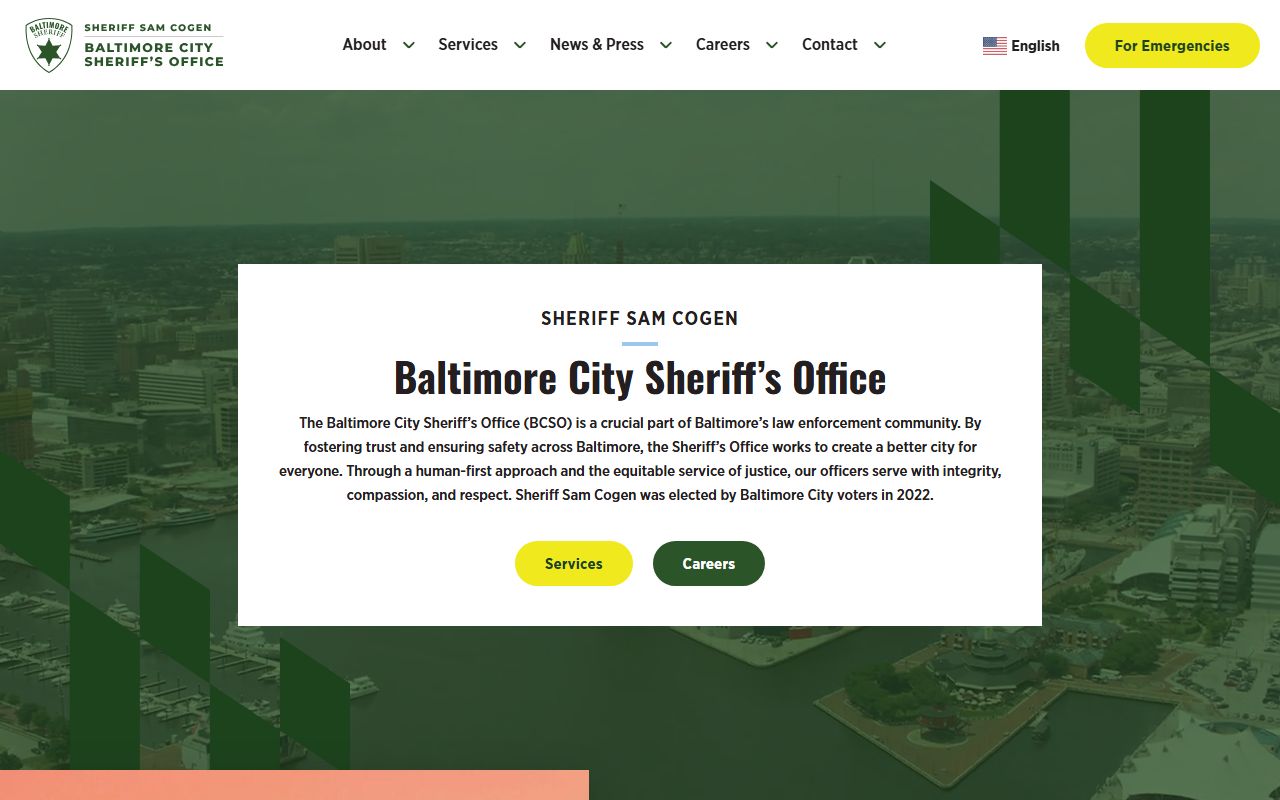
The page confirms the office's duties without offering a public warrant database, which lines up with what the research found.
Types of Warrants in Baltimore City
Not all warrants are the same. Each type comes from a different trigger and serves a different purpose. Some lead to arrest. Others authorize a search. A few come up only in civil or family matters. The list below covers the main kinds you may run into.
- Arrest warrant – issued on probable cause to take a person into custody.
- Bench warrant – issued by a judge, often for failure to appear, contempt, or breaking a court order.
- Search warrant – authorizes a search of a place, person, or property, and may be sealed during an investigation.
- Fugitive or retake warrant – may involve out-of-jurisdiction custody or extradition.
- Violation of probation warrant – issued when a probation violation is alleged.
- Civil body attachment – a contempt-based order that may issue in limited civil or family cases.
How to Search Baltimore City Warrants
Because no public warrant portal exists, the practical search runs through case records. Case Search may show a served or recalled warrant as a docket entry on a known case. It will not show an unserved warrant. The free Maryland Judiciary Case Search is the closest public tool, and it works only when a case already exists.
- Open Case Search and pick Party Name Search, then select Baltimore City.
- Look for the case tied to the matter and open the docket.
- Scan the docket entries for a warrant event, such as a bench warrant issued or recalled.
If nothing shows, that does not mean no warrant exists. An unserved warrant stays hidden. The safer path is to talk to a lawyer or the Office of the Public Defender, who may be able to check status without putting you at risk. Avoid private warrant-lookup sites, which are not official and may post stale or wrong data. The only reliable public court tool is Case Search, and even that depends on an open case with a served or recalled warrant event.
Baltimore City Warrant Search Fields
When you use Case Search to look for a warrant-related docket entry, you work with the standard party-name fields. There is no separate warrant-only search form for the public. The fields below are the ones Case Search uses for a name search.
| Field Label | Type | Required | Notes |
|---|---|---|---|
| Last Name | Text | Yes | Exact-name default; add a percent sign for a partial name. |
| First Name | Text | No | Narrows a broad party search. |
| Jurisdiction | Dropdown | No | Select Baltimore City to localize the search. |
| Filing Date Range | Date | No | Trims results under the 500-record cap. |
What a Baltimore City Warrant Record Shows
When a warrant event does appear in a court or docket source, it carries a set of common fields. The detail varies by case and by access rules. Bond, for example, is not always public online. The table lists the fields you may see.
| Field | What It Shows |
|---|---|
| Case Number | The case tied to the warrant, found on Case Search or a court notice. |
| Issuing Court | Circuit Court or a District Court location. |
| Party / Defendant | The person the warrant names. |
| Charge or Matter | Criminal, traffic, probation, or contempt basis. |
| Warrant Event | Issued, recalled, served, quashed, or body attachment. |
| Bond | May be set by a judge or commissioner; not always public online. |
| Next Court Date | Must be confirmed with the clerk or counsel. |
How to Resolve a Baltimore City Warrant
Clearing a warrant takes care. The wrong move can lead straight to arrest. The right move starts with information and counsel. The steps below lay out a safe order of operations. Do not skip the legal advice step on a criminal warrant.
- Check Case Search for any known case number and the next court date.
- Contact defense counsel or the Office of the Public Defender if you may be eligible.
- Ask the issuing court clerk for procedural details, if it is safe to do so.
- For a criminal warrant, consult counsel before appearing, since appearing may result in arrest.
- If turning yourself in, confirm the location, hours, bond rules, medication needs, and property limits first.
- After a recall or quash order, keep copies and confirm the record was updated.
For help finding eligible counsel, the Maryland Office of the Public Defender explains who qualifies and how to apply. Getting advice first is the single most important step.
What to Do If You Have an Outstanding Warrant
An open warrant does not go away on its own. It can surface at a traffic stop, an airport, or a routine check. Still, the answer is not to rush to a station or courthouse without a plan. Bond, charge type, and court status all shape the right move. A lawyer can often arrange a safer way to address the warrant, sometimes through the court rather than a surprise arrest.
Important: Talk to a lawyer or the Office of the Public Defender before you turn yourself in or appear, because showing up on an active criminal warrant may result in arrest.
Restricted Baltimore City Warrant Records
Several warrant records stay out of public view by design. Unserved arrest warrants are not shown on Case Search. Search warrants may be sealed during an active investigation. Some warrants tied to grand jury work fall under secrecy rules; grand jury proceedings are kept secret under Courts and Judicial Proceedings § 9-109. Juvenile and federal warrants follow their own access limits.
This is why a clean Case Search result is not proof that no warrant exists. The most reliable status check comes through counsel. For how arrest and charge data connects to warrants, see the arrest records page. For the broader court file, see the court records page, and for the trial court itself, the Circuit Court page.
Note: Do not rely on third-party warrant databases, since they are not official, may be wrong, and can mislead a person into a risky in-person visit.
Posting Bond on a Baltimore City Warrant
Planning matters if you decide to clear a warrant in person. A judge or court commissioner may set a bond as a condition of release. Bond can be cash, a percentage, or a surety through a bondsman. The amount and type are not always posted online, so you may not know the figure until you stand before the commissioner. Confirm medication needs, property rules, and the location and hours before you go.
The Baltimore City Sheriff's Office handles courthouse security, civil process, evictions, and warrant work. Arrests in the city are booked through state-run Central Booking, not a county sheriff jail. A person who turns themselves in moves through that intake process and then appears before a commissioner for an initial bail decision. For custody status after booking, use the inmate records page.
Counsel should come first. The Maryland Office of the Public Defender represents eligible people in criminal and incarcerable-traffic cases. An attorney can check warrant status, ask the court to recall or quash a bench warrant, and plan a safe surrender. After a warrant is recalled or quashed, keep the order and confirm the record was updated.