
About the Baltimore City Clerk's Office
The Clerk of the Circuit Court for Baltimore City is Xavier A. Conaway. The Maryland Judiciary directory names him as Clerk of Court and notes the Clerk's Office sits in the Elijah Cummings Building. The clerk is the local record custodian for Circuit Court case files. That covers civil, criminal, family, and certain juvenile matters where the law allows.
The office does more than hold files. It takes new filings, manages the court record, issues process, and collects fees. It also runs the Assignment Offices that set cases for hearing. The clerk works under statewide Maryland Judiciary rules but serves Baltimore City directly. For an overview of the court itself, see the Baltimore City Circuit Court page.
Clerk of the Circuit Court for Baltimore City
Clerk: Xavier A. Conaway
100 North Calvert Street
Baltimore, MD 21202
410-333-3722
Mon–Fri 8:30 a.m. to 4:30 p.m.
What the Clerk Does in Baltimore City
The clerk is the front door to the court record. Staff accept and stamp new cases, keep the docket current, and pull files for the public to view. The Maryland State Archives page for Baltimore City judicial functions says the Clerk of the Circuit Court runs the Assignment Offices and six divisions. Each division handles a slice of the work.
The six divisions split the load by case type and task. The list below shows what each one covers.
- Civil – processes and manages civil, nondomestic matters within Circuit Court reach.
- Criminal – holds felony and other Circuit Court criminal case files.
- Family – manages divorce, custody, support, and related domestic files.
- Jury – handles juror summons, panels, and jury service.
- Juvenile – keeps juvenile court files, most of which are confidential.
- Land Records and Licenses – records deeds and liens and issues marriage and business licenses.
Court files live with the clerk where the case was heard. Case Search is only a summary. To read the full file or get a stamped copy, you deal with this office, not a third-party site.
Land Records and Licenses Division
The Land Records and Licenses Department records deeds, mortgages, liens, and similar instruments for property in the city. It also issues marriage and business licenses. The division sits in the Clarence M. Mitchell, Jr. Courthouse at 100 North Calvert Street. Land Records work runs out of Room 610, while marriage and business licenses are handled in Room 627.
You can read more about how the division works on the official Land Records and Licenses Division page, which lays out hours, rooms, and contact lines.
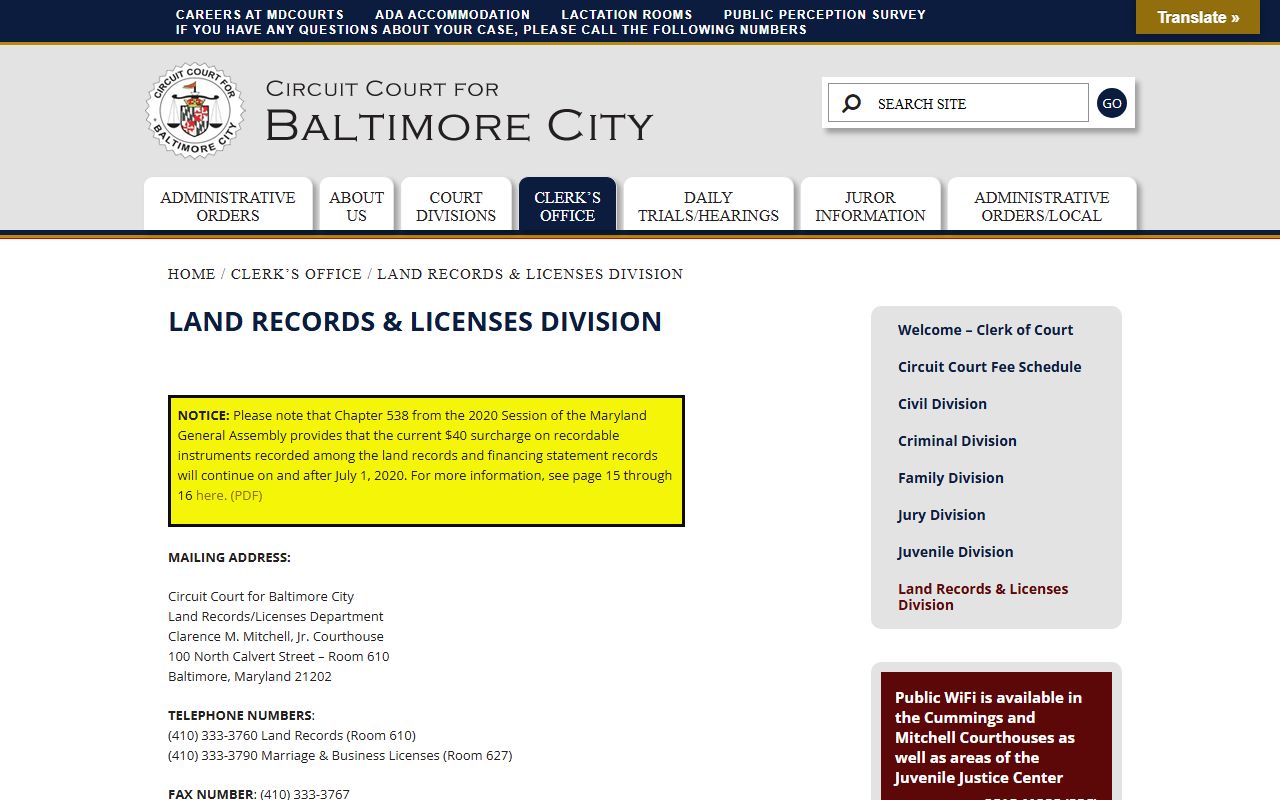
That page is the source for the room numbers, phone lines, and hours used throughout this office. Two contact cards below pull those details together for quick reference.
Land Records – Room 610
Clarence M. Mitchell, Jr. Courthouse
100 North Calvert Street, Room 610
Baltimore, MD 21202
410-333-3760
Fax: 410-333-3767
Mon–Fri 8:30 a.m. to 4:00 p.m.
Marriage & Business Licenses – Room 627
Clarence M. Mitchell, Jr. Courthouse
100 North Calvert Street, Room 627
Baltimore, MD 21202
410-333-3790
Mon–Fri 8:30 a.m. to 4:00 p.m.
Cash registers close at 4:00 p.m.
Library and research hours are longer. The reading room is open Monday through Thursday from 8:30 a.m. to 6:15 p.m., and Friday from 8:30 a.m. to 4:45 p.m. Cash registers still close at 4:00 p.m. for all license and land-record payments, so plan ahead.
Land records are also online. The state image system, MDLandRec, lets you view recorded deeds and liens after you create a free account. The Maryland Judiciary court-records page points to the same system for online land records. This is a separate tool from Case Search.
Note: Marriage licenses for Baltimore City weddings must be issued by this office, since a Maryland license is valid only in the jurisdiction that issued it.
Requesting Baltimore City Court Case Files
Most case files stay at the courthouse where the case was heard. Maryland Judiciary guidance says anyone may view records in person at the clerk's office, with limited exceptions. The best tool to bring is a case number. If you do not have one, the clerk may be able to find the file using the names of the people involved.
One firm rule shapes how you ask. The clerk's office cannot take telephone requests for added case information. Requests must come in person or in writing. So a phone call works to confirm hours or fees, but not to pull case details. For the online summary that points you to the right file, the Baltimore City court records page walks through Case Search.
Note: The clerk cannot accept telephone requests for case information, so plan to visit the office or send a written request with the case details.
How to Request a Certified Copy
A certified copy is a copy the clerk attests to as a true match of the record on file. Courts, agencies, and many out-of-state offices want certified copies, not plain printouts. A plain copy is fine for personal reading, but it will not stand in as proof. The steps below cover a typical request.
- Find the case number first. Use Case Search or your own paperwork to confirm the court, case type, and parties.
- Decide what you need. Note the document, the copy type, and how many certified copies you want.
- Make the request in person at the clerk's office or send a written request by mail, since phone requests are not accepted.
- Pay the fee. Plain copies cost less; certified copies cost more because the clerk attests to them.
- Pick up the copies, or include a return address and postage for a mail request to avoid the extra mail charge.
For marriage certified copies, work with Room 627 and confirm the charge before you mail payment. Estate and will copies come from a different office, the Register of Wills, covered on the Baltimore City probate records page.
Records Request Form Fields
A written request should give the clerk enough to locate the file and fill the order. There is no single magic form for every record type, but the same core details apply. The table lists what to include on a request to the Baltimore City clerk.
| Field | Required | Notes |
|---|---|---|
| Case Number | Strongly recommended | Used by the clerk to locate court records. |
| Names of Persons Involved | Optional if case number is known | Clerk may use names to find a file when the number is missing. |
| Record Type | Yes | Civil, criminal, family, land record, marriage license, or judgment. |
| Copy Type | Yes for copy requests | Plain, certified, instrument copy, or marriage certified copy. |
| Return Mailing Address | Yes for mail requests | Include postage or expect an added mail charge. |
| Payment | Yes for copies and fees | Checks for land-record work are payable to Circuit Court for Baltimore City. |
Baltimore City Clerk Fees
Copy fees at the clerk's office are set and modest. Plain copies run a flat rate per page. Certified copies cost more, since the clerk attests to each one. A mail request without return postage adds a small charge. The table lists the common items from the Land Records and Licenses fee schedule.
| Item | Amount |
|---|---|
| Copies per page | $0.50 |
| Certified copy per instrument | $5.00 |
| Mail request without return postage | Add $2.00 |
| Basic recording, 9 pages | $20.00 plus $40 surcharge where applicable |
| Notary new commission | $11.00 |
| Authentication of notary | $1.00 per document |
These amounts can change, so confirm the current charge before you send a check. Recording fees rise with page count and surcharges, so a deed or a power of attorney may cost more than a simple copy.
Finding the Clerk in the Courts Directory
The Maryland Judiciary keeps an official directory for each jurisdiction. The Baltimore City listing names the clerk, gives the main number, and links the courthouse address. It is a good first stop to confirm a contact line before you visit.
You can open the city listing through the Maryland Judiciary courts directory for Baltimore City, which is the source for the clerk's name and main contact.
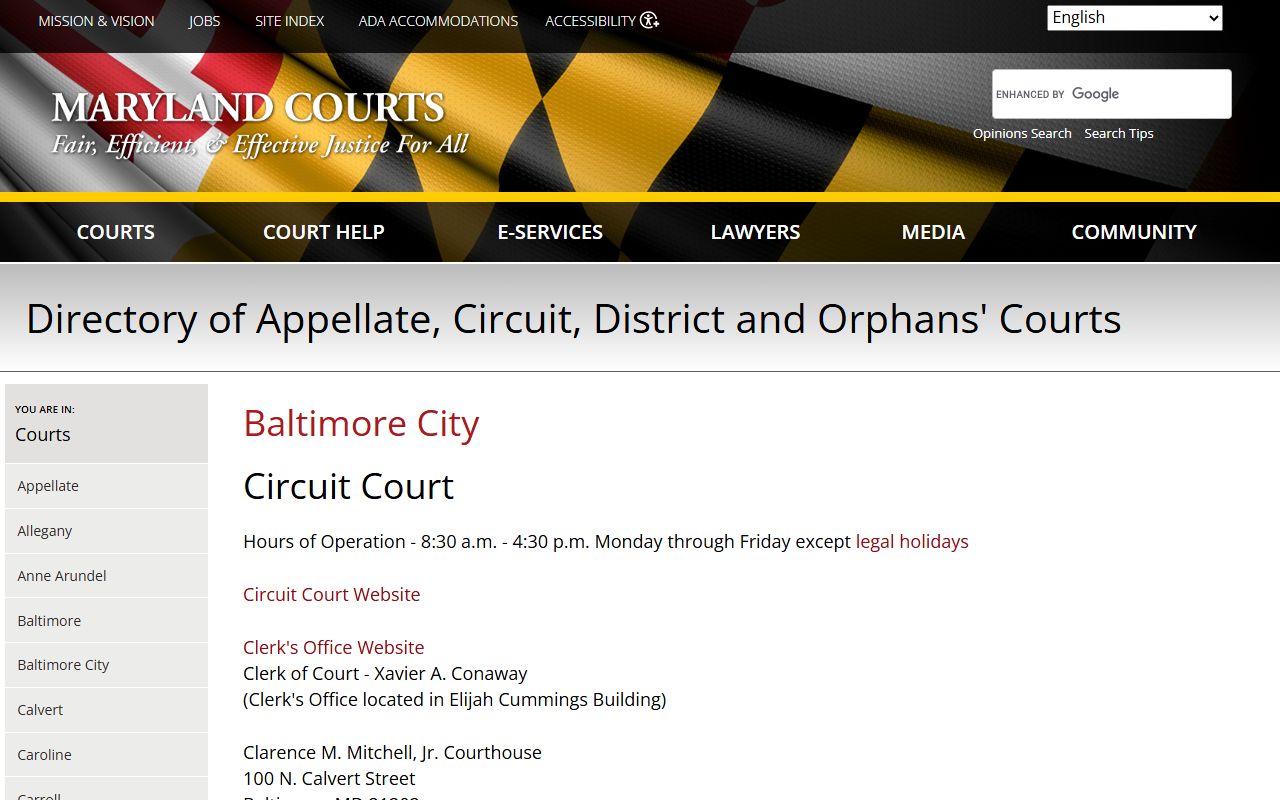
The directory page also links the Circuit Court and the District Court locations, so it doubles as a map to the wider city court system.
E-Filing Through MDEC
Baltimore City joined Maryland Electronic Courts, or MDEC, on May 6, 2024. That move completed a statewide rollout that began in 2014. It tied the city's Circuit and District Courts into one statewide case system. The change made e-filing mandatory for attorneys in civil and criminal cases.
Self-represented people are not forced to e-file, so they can still file on paper at the clerk's counter. Learn more on the official Maryland Electronic Courts page. Once a case is in MDEC, the clerk manages it inside that statewide framework.
Records the Clerk Does Not Handle
Some records people expect from the clerk are kept elsewhere. Knowing the right office saves a wasted trip. Two big ones come up often in Baltimore City.
Estate and will matters do not go through the Circuit Court clerk. They are handled by the Register of Wills and the Orphans' Court. To search estates or order a probate copy, see the probate records page. Jail and detention records are also outside the clerk's reach. Baltimore City detention is run by the state, through the Department of Public Safety and Correctional Services, not by the clerk. To find someone in custody, use the DPSCS Incarcerated Individual Locator or read the Baltimore City inmate records page.