
What Baltimore City Probate Records Cover
Probate is how the state settles what a person owned after they die. It moves the assets to heirs, pays debts, and closes the estate. Baltimore City probate records hold the wills, the estate files, the inventories, and the orders that go with that work. They also cover guardianship of a minor's property and a few related estate matters. Most of these records are open to the public, since probate is a court-supervised process.
Maryland splits the job between two offices. The Register of Wills opens estates, takes filings, and stores the files. It is the day-to-day record keeper for Baltimore City estates. The Orphans' Court is the judicial side. It steps in when there is a contest, a lost or damaged will, a fight over who should serve, or another dispute that needs a judge. So a routine estate runs through the Register, while a contested one goes before the Orphans' Court. Both feed the same set of probate records.
Baltimore City Register of Wills Contact
The Register of Wills for Baltimore City is the Honorable Belinda K. Conaway. The office sits in Courthouse East downtown, on the third floor. Staff ask that you call for an appointment first. Appointments are taken ahead of walk-ins, and a walk-in who arrives after 3:00 p.m. may be served the next business day. The office cannot accept filings by email, so plan to file in person or by mail.
Register of Wills for Baltimore City
Courthouse East, 3rd Floor
111 North Calvert Street
Baltimore, MD 21202
410-752-5131
Toll-free 888-876-0035
Fax 410-752-3494
Mon–Fri 8:30 a.m. to 4:30 p.m.
The same building houses the Orphans' Court for Baltimore City, which hears contested estate and guardianship matters. The office is closed on weekends and State holidays. For office details, appointment notes, and the security notice, the Baltimore City Register of Wills posts current information online.
The county page lays out the office address, hours, and the appointment request in plain terms.
A look at the Baltimore City Register of Wills page shows the office contact block and policies before you visit.
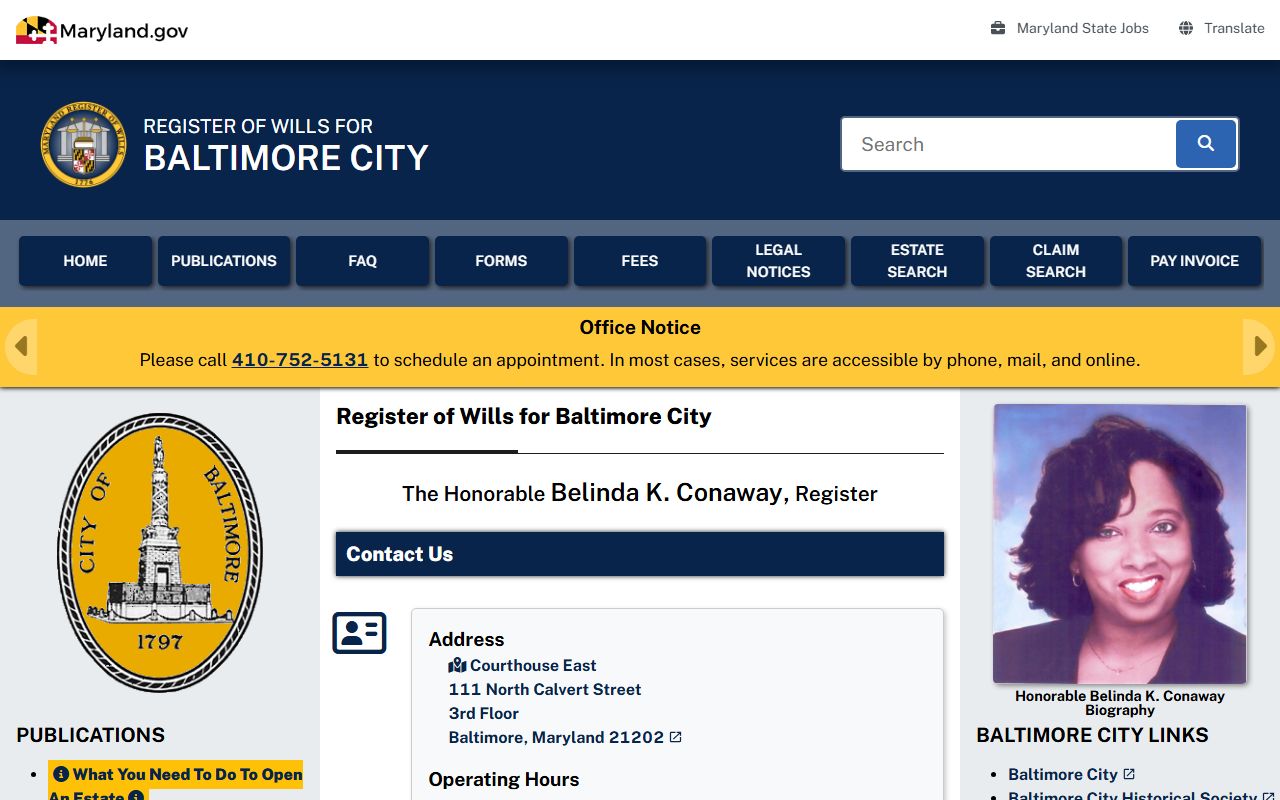
Use it to confirm the floor, the appointment rule, and whether you need to bring anything before you go.
How to Search Baltimore City Probate Records
The main tool is the Maryland Register of Wills Estate Search. It gives public Internet access to estate case records kept by the state's Registers of Wills. Access runs under Maryland Rules 16-900 and the rules that follow. You can look up an estate by the decedent's name or by the estate number. The system covers estates from 1998 to the present, with some older county entries, and updates once a day at the end of business. Records stay in the system unless a court orders them removed.
- Open the official Estate Search page and read the disclaimer. Click "I Agree To The Terms And Conditions" to go on.
- Pick Baltimore City as the jurisdiction to narrow the search.
- Type the decedent's last name. A percent sign works as a wildcard, so type the first letters plus % for a partial name.
- To use an estate number, enter all 12 characters and add leading zeros if the number is shorter.
- Add a filing date range if you have one. A date range needs a first or last name.
- Run the search, then open the matching estate to see the case number, status, and docket.
- For the full file or a certified copy, contact the Register of Wills office.
The Estate Search disclaimer and access page explains the rules before you start.
You can reach the tool from the Register of Wills Estate Search page, which shows the terms you must accept first.
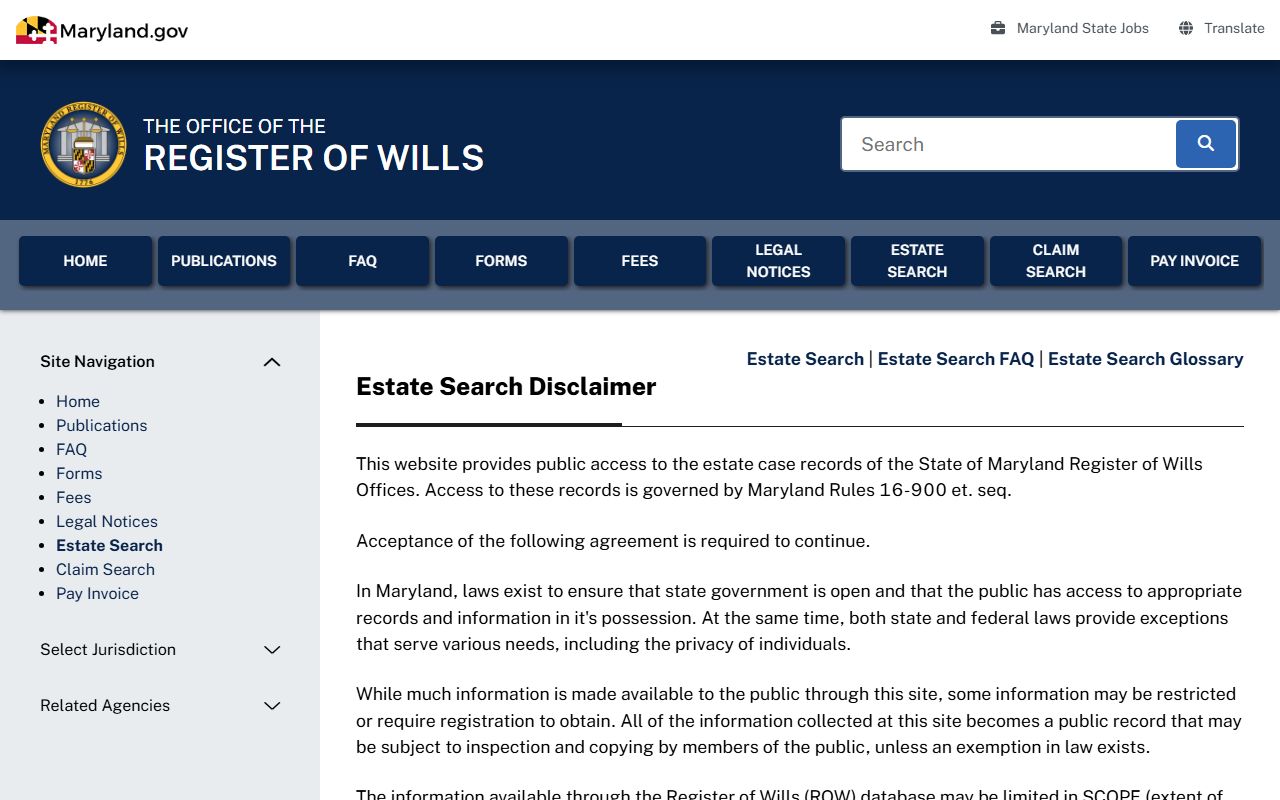
Once you accept the terms, the search form opens with the jurisdiction and name fields described below.
| Field Label | Type | Required | Notes / Format |
|---|---|---|---|
| Agreement buttons | Button | Yes | Accept the terms and conditions to reach the form. |
| Jurisdiction | Dropdown | Recommended | Select Baltimore City to narrow the search. |
| Decedent last name | Text | Conditional | Wildcard % supported for partial names. |
| Decedent first name | Text | No | Narrows the result set. |
| Estate number | Text | No | Use the full 12 characters; add leading zeros. |
| Filing date range | Date | No | Requires a first or last name; partials allowed. |
| Estate type | Dropdown | No | RE, SE, RJ, SJ, FP, MV, NP, UN, MA, GE, LO. |
Note: Estate Search returns a summary of the estate file, so the full record may still require a visit to the Register of Wills office.
What Baltimore City Probate Records Show
An Estate Search result lists a core set of fields. You see the decedent's name, the estate number and status, the date of death, and the filing date. It also names the personal representative and the attorney, lists any decedent alias, and shows the docket history. The county of filing appears as well. For Baltimore City, that field reads Baltimore City.
The estate file behind the search holds more. It can include the will, the petition for probate, inventories that list the assets, accountings that track money in and out, and the orders that distribute property and close the estate. Plain documents are not always online. To read the full file, you may need to visit the office or work with the staff. The docket history in Estate Search tells you what has been filed and when.
Estate Types in Baltimore City Probate Records
Estate Search uses short codes for each kind of estate. The code tells you how the estate is being handled and roughly how large it is. Most Baltimore City estates fall under a handful of these codes. The list below pairs each code with its meaning.
| Code | Estate Type |
|---|---|
| RE | Regular Estate: assets over $30,000, or over $50,000 if the spouse is the sole heir. |
| SE | Small Estate: assets of $30,000 or less, or $50,000 or less if the spouse is the sole heir. |
| RJ | Regular Estate Judicial: an Orphans' Court proceeding when matters cannot be handled at the counter. |
| SJ | Small Estate Judicial: the judicial track for a small estate dispute. |
| FP | Foreign Proceeding: an out-of-state decedent who owned Maryland real property. |
| MV | Motor Vehicle: transfer of a motor vehicle only. |
| NP | NonProbate: property that passes by operation of law. |
| UN | Unprobated Will Only: a will or information report filed without full probate. |
| MA | Modified Administration: a streamlined option for a solvent estate that can close within 12 months. |
| GE | Guardianship Estate: guardianship of property for a minor. |
| LO | Limited Order: an order to locate assets or a will. |
Small vs Regular Estates in Baltimore City
The dollar value of the estate sets the track. A small estate holds assets of $30,000 or less. That cap rises to $50,000 when the surviving spouse is the only heir or legatee. A regular estate holds more than those amounts. Small estates move faster and need fewer steps. Regular estates take more filings, more notice, and a longer timeline.
A few options sit between the two. Modified Administration is a streamlined path for a solvent estate, but only when the people who inherit are the personal representative, the spouse, and the children, and the estate can close within 12 months. A Foreign Proceeding handles an out-of-state decedent who left real property in Maryland. If you are not sure which track fits, call the Register of Wills before you file. The office can confirm the documents you need and set an appointment.
The Orphans' Court Role in Baltimore City
The Orphans' Court for Baltimore City is the judicial side of probate. It does not handle every estate. Routine estates run through the Register of Wills at the counter. The court steps in when there is a fight. That can be a contest over a will, a question about whether a will is valid, a lost or damaged will, a dispute over who should serve as personal representative, or a disagreement over accountings.
In Estate Search, these matters carry the judicial codes. A Regular Estate Judicial shows as RJ. A Small Estate Judicial shows as SJ. The court also reviews guardianship of a minor's property and signs orders that the Register then files. So a contested estate and a routine one both leave probate records, but the path differs. For the broader court structure, see the Circuit Court page, since other family and civil matters route through that court instead.
Safekeeping Wills in Baltimore City
The Register of Wills can hold a will for safekeeping during a person's life. These wills are not public. They are not part of Estate Search. The office releases a safekeeping will only to the testator, the person who made it. The testator must pick it up in person and bring a copy of a driver's license. No one else can collect it while the testator is alive.
After a death, a safekeeping will is opened and moves into the probate process like any other will. If you think the office holds a will for a relative who has died, call first. The staff can tell you the next step and what proof you need. To start any probate filing, the office asks that you call to confirm the documents and set an appointment.
Probate Terms Defined
Probate uses words that trip up many readers. The short list below covers the ones you will see most often in Baltimore City estate files and on Estate Search.
- Testator
- The person who made the will.
- Personal Representative
- The person who settles the estate, also called the executor.
- Intestate
- Dying without a valid will, which sends the estate to default heirship rules.
- Decedent
- The person who has died and whose estate is being handled.
- Guardianship
- A court-approved arrangement to manage the property of a minor.
Baltimore City Probate Forms and Fees
Maryland keeps a statewide forms library for probate. You can download the petitions, the inventory forms, and the account forms there, then file them with the Baltimore City office. Local staff can help you pick the right form for a small or regular estate. The office cannot take filings by email, so file in person or by mail.
The forms library lets you choose a jurisdiction and pull the matching PDF forms.
The Register of Wills forms library holds the statewide probate forms you may need.
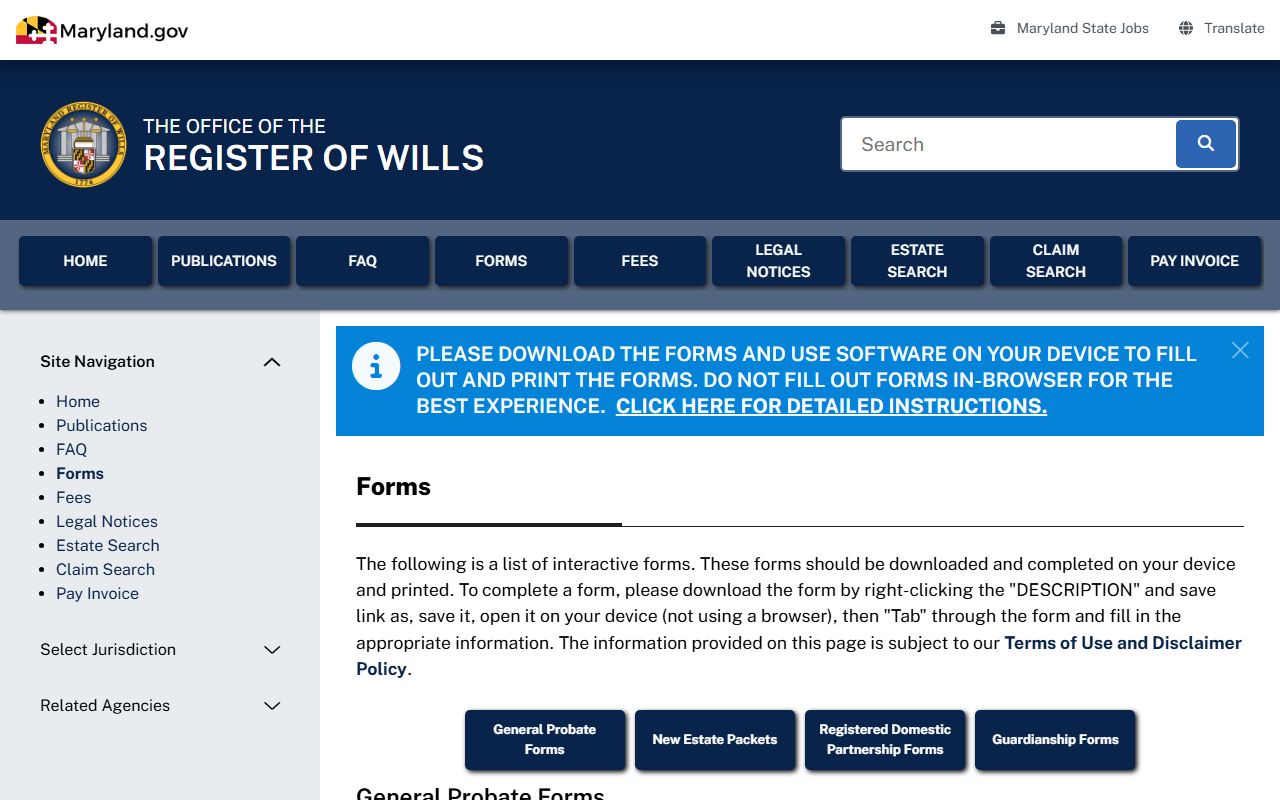
Download the form you need, fill it out, and bring it to your appointment with the supporting papers.
Estate guides and fee materials sit in a separate spot. They explain estate types, walk through the steps, and lay out costs. Probate fees in Maryland are set by statute and rise with the value of the estate, so confirm the current amount with the office before you file.
The publications page gathers the estate guides and fee explanations in one place.
You can read the estate guides on the Register of Wills publications page, which covers estate types and costs.
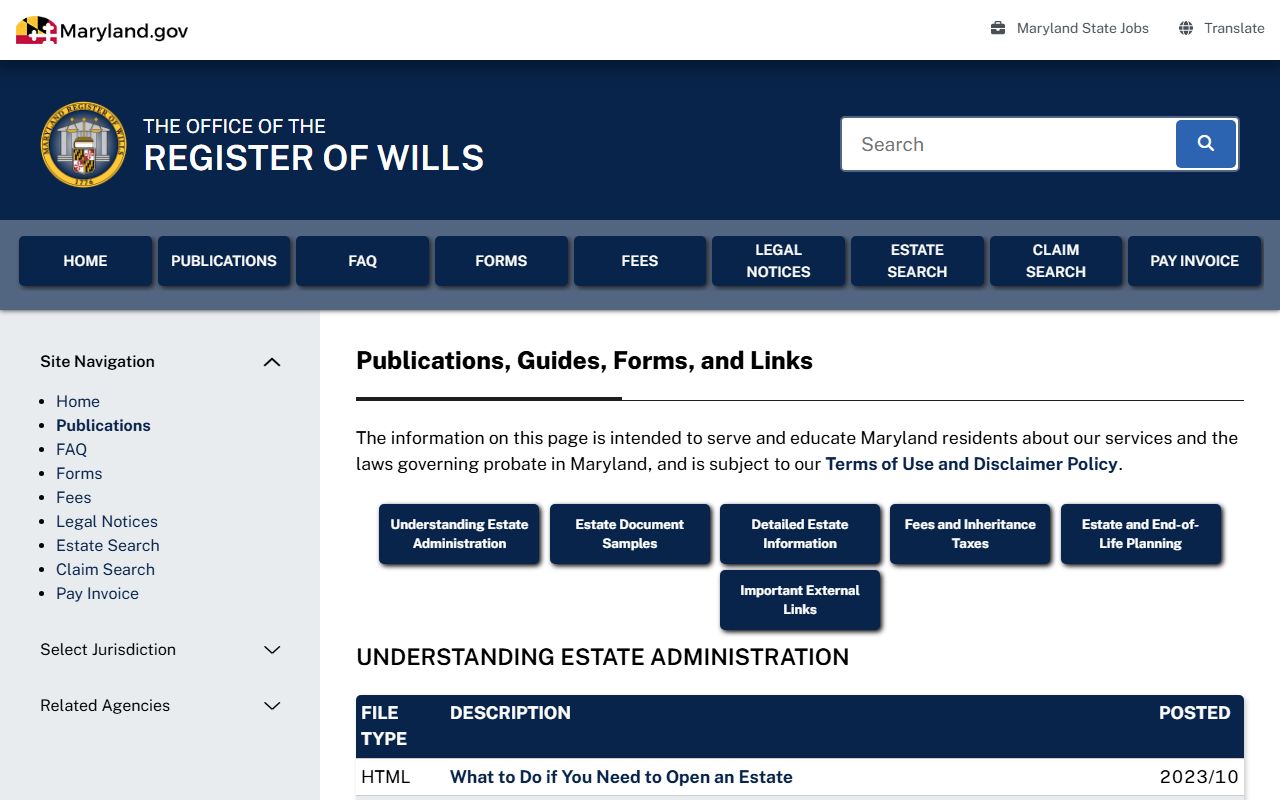
Pair the guides with the forms library so you bring the right documents and the right payment.
Note: Probate filing fees in Maryland scale with the value of the estate, so check the current fee schedule with the Register of Wills before you send any payment.
Restricted Baltimore City Probate Records
Most probate records are public. A few are not. Safekeeping wills stay closed while the testator lives. Guardianship files that involve a minor's property can carry privacy limits, since they touch a child. Mental-health and medical material tied to an estate or guardianship is not open without a court order. A court can also seal a specific record on request.
For broader access rules and how to request agency records, see the public records page. If a record is confidential, the office cannot release it at the counter. You may need a court order or proof that you are an authorized party, such as the personal representative or an attorney of record.