
Baltimore City Inmate Search Basics
Most counties run a jail and post a sheriff's roster. Baltimore City does not. Jail and pretrial detention in the city are state functions, handled by the Maryland Department of Public Safety and Correctional Services. The Baltimore City Sheriff's Office still does courthouse security, civil process, evictions, and warrant work. But the people held after arrest sit in state facilities. That changes how an inmate search works in the city.
Everyone arrested in Baltimore City, or picked up on a city warrant, comes through the Division of Pretrial Detention and Services. That division includes the Baltimore Central Booking and Intake Center, which opened in 1995. To find a person in custody, the state offers an online tool. It pulls from the same statewide system used for the rest of Maryland.
The state locator does not show everyone. It lists people housed at Division of Correction facilities, Patuxent Institution, and some short-sentenced people at pretrial facilities. It may skip some short-sentenced detainees. It does not list people who have left custody by release, escape, or any other reason. So a blank result is not proof a person was never held. To confirm a recent exit, see the released inmates page.
How to Use the Baltimore City Inmate Locator
The tool to use is the DPSCS Incarcerated Individual Locator. It is free and open to the public. You do not need an account. A full legal name gives the best result, since the search runs on names. The state's own help text describes what the locator covers, so it pays to read the page note before you search.
The locator page explains the search and its limits in plain terms. Below is the official page that hosts the tool.
The screenshot comes from the DPSCS Incarcerated Individual Locator.
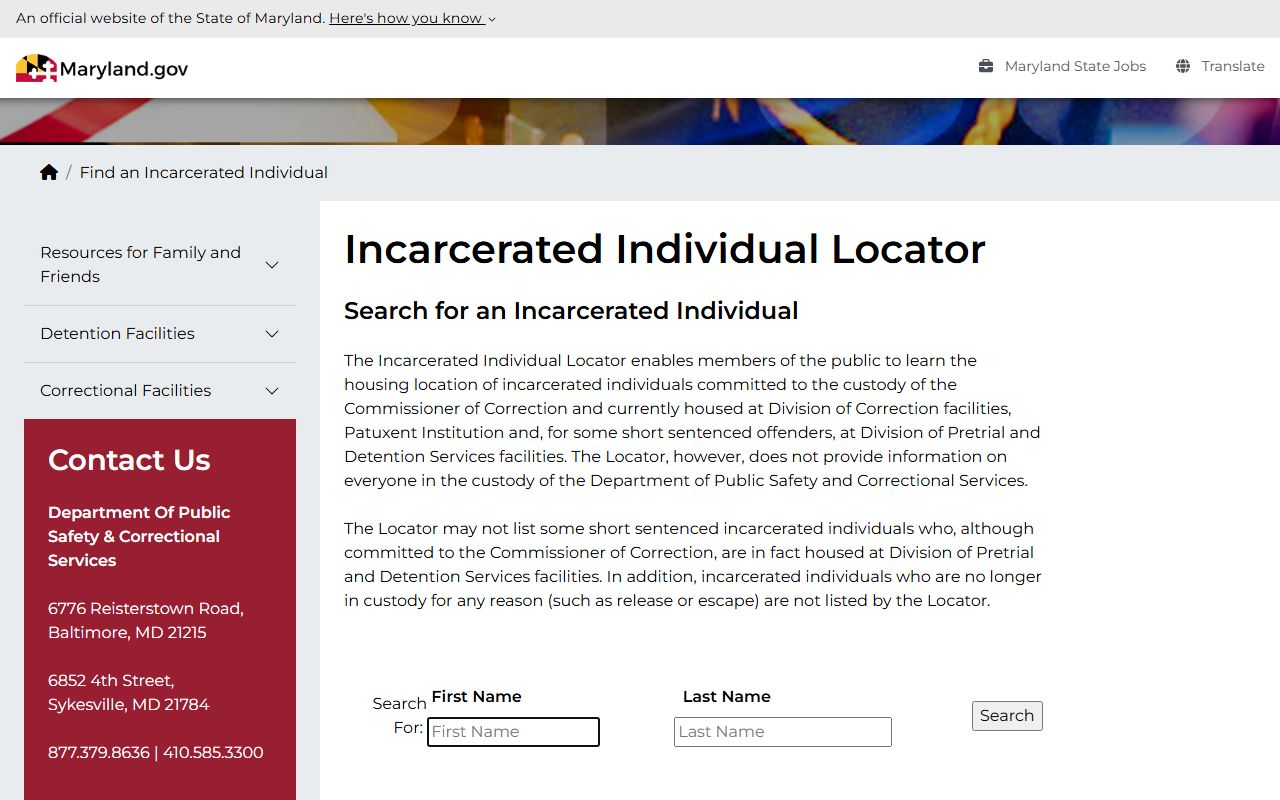
That same page is where you type a name and run the search for a Baltimore City inmate.
- Open the official DPSCS locator. Skip third-party search sites and copycat tools.
- Enter the last name. Add the first name to narrow a common name.
- Use the legal spelling if you know it, since the search matches on the name.
- Run the search and read the list of results.
- Check the housing location shown for the person you want.
- If no match appears, call the booking center, since the tool omits some detainees and all released people.
Treat the locator as a starting point. It tells you if a person is currently listed and where. It does not give charges, bond, or court dates. For those, run a name through Maryland Judiciary Case Search or check the arrest records page.
Inmate Locator Search Fields
The locator keeps its form short. There are only a few inputs. You search for an incarcerated individual by name, then submit. The table lists each field and how it works.
| Field Label | Type | Required | Notes |
|---|---|---|---|
| Search For | Text group | Yes | The page is set to search for an incarcerated individual. |
| First Name | Text | No | Add it to narrow a common last name. |
| Last Name | Text | Strongly advised | Use the legal spelling if you know it. |
| Submit / Search | Button | Yes | Runs the locator search. |
Note: A name miss can mean the person was released, is a short-sentenced detainee the tool skips, or is held under a different spelling, so call to confirm.
What a Baltimore City Inmate Record Shows
The state locator is built to show housing, not a full booking sheet. Its purpose is to tell the public where a person committed to state custody is held. That is a narrow set of facts. A county jail profile often shows more, but the city does not run one. The table below lists what the result will and will not show.
| Field | What It Shows |
|---|---|
| Name | The incarcerated person's name as listed in the state system. |
| Housing Location | The facility where the person is currently held. |
| Custody Status | Whether the person is currently listed in state custody. |
| Charges | Not shown by the locator; check Case Search instead. |
| Bond Amount | Not shown by the locator; ask the court or check the case file. |
| Court Date | Not shown by the locator; use the case record for hearing dates. |
To get charges, bond, and dates, pair the locator with the court record. The locator answers "where," and the case file answers "what" and "when." That split is the key thing to grasp about a Baltimore City inmate record.
Baltimore City Detention Facilities
Several state facilities sit in Baltimore and hold city detainees. The Central Booking and Intake Center is the front door for almost every city arrest. Other sites handle reception, transition, youth detention, and high-security holds. The locator may place a person at any of them. The table lists the main facilities tied to Baltimore City detention.
| Facility | Location | Role |
|---|---|---|
| Baltimore Central Booking & Intake Center (BCBIC) | Baltimore | Primary booking and intake; designed capacity listed as 954. |
| Chesapeake Detention Facility (CDF) | Baltimore | Detention facility listed by the state. |
| Maryland Reception, Diagnostic and Classification Center (MRDCC) | Baltimore | Intake, reception, and classification. |
| Metropolitan Transition Center (MTC) | Baltimore | Detention and correctional transition. |
| Youth Detention Center (YDC) | Baltimore | Youth detention facility. |
The two offices most people need to reach are the booking center and the pretrial division that runs it. Their contact details are below. For facility counts and capacity, the inmate population page goes deeper.
The booking center's facility page lists wardens and detainee service numbers.
The screenshot is from the Baltimore Central Booking and Intake Center page.
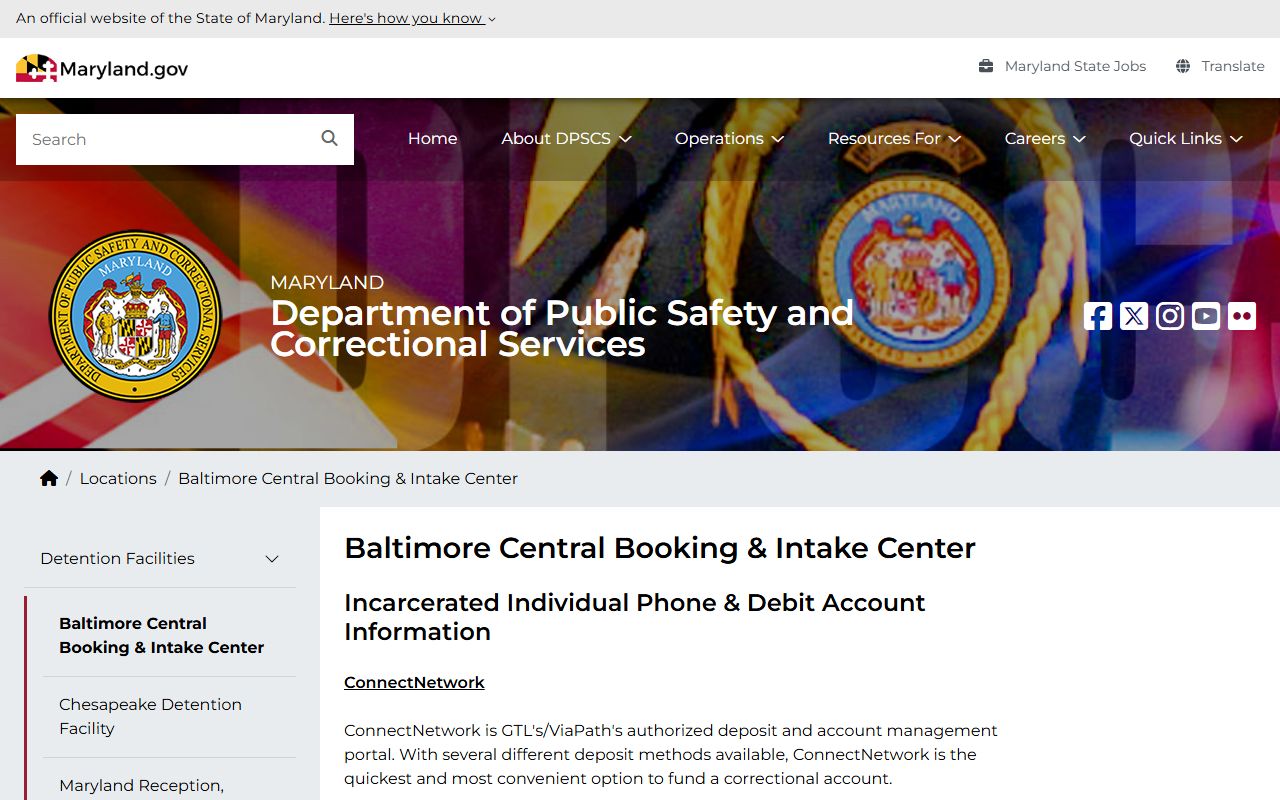
Use that page to confirm the current address and the right service number before you call.
Baltimore Central Booking & Intake Center
300 E. Madison Street
Baltimore, MD 21202
410-545-8080
Warden: Rosalyn McDuffie
Division of Pretrial Detention and Services
The O'Brien House, 521 E. Eager Street
Baltimore, MD 21202
410-230-1434
Handles all Baltimore City arrests
The pretrial division oversees booking, the detention center, and the pretrial release program.
The screenshot is from the Division of Pretrial Detention and Services page.
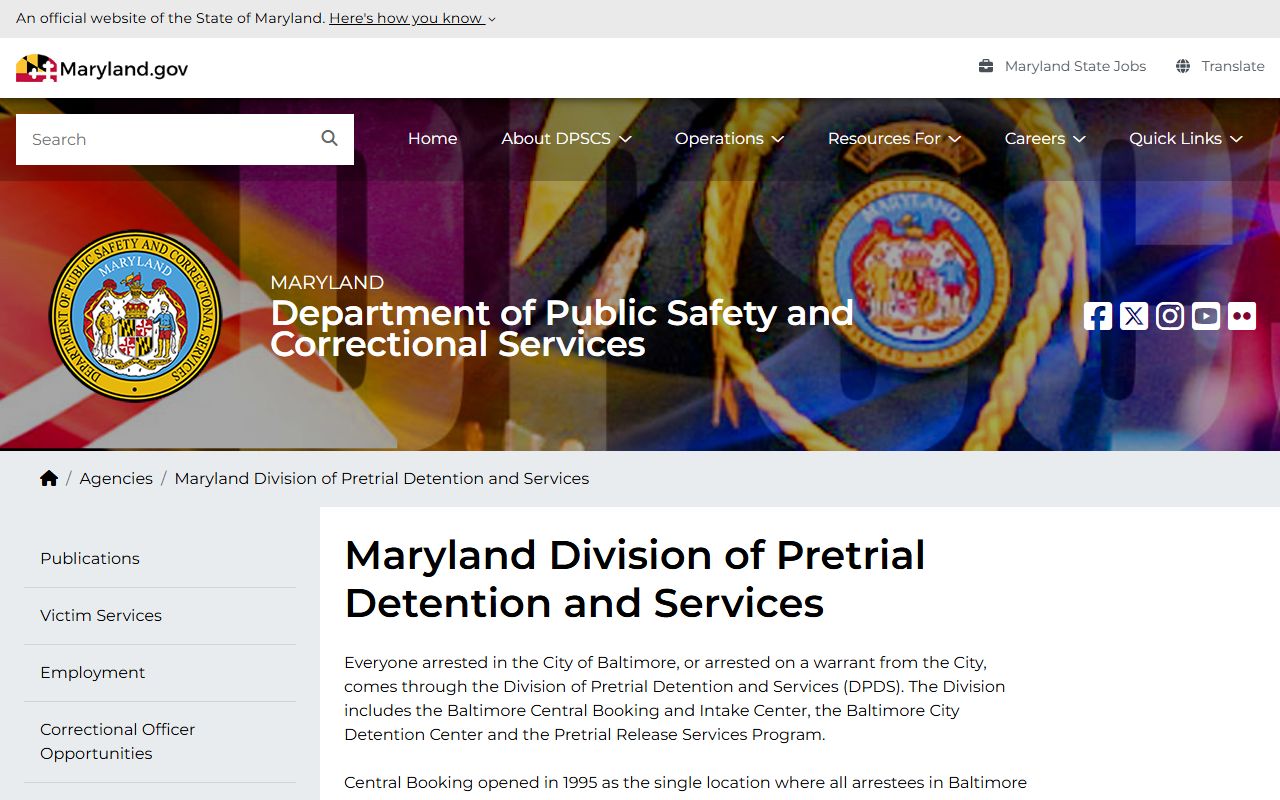
That page confirms the division's role and that every city arrest runs through it.
Booking Process for Baltimore City Inmates
Arrest is only the first step. After it, a person enters the state's pretrial system. Everyone arrested in the city, or held on a city warrant, comes through the Division of Pretrial Detention and Services. The booking center handles intake. Processing covers transport, intake, identity work, holding, and a charging review.
From there, the case moves toward a first appearance. A court commissioner or judge reviews charges and sets the terms of release or detention. Some people post bond and leave. Others are released on their own recognizance or through pretrial release. Some are held to await trial. The exact path depends on the charge and on what the court orders.
The state does not publish a minute-by-minute booking timeline for the public. So times vary. If you need the status of a person just arrested, the most reliable move is to call the booking center directly. Charges, bond, and hearing dates show up in the court file, not the locator. The warrant records page explains how a warrant arrest reaches booking.
Baltimore City Inmate Visitation
Visits work by request, and the request goes by email. Each facility has its own visitation email. You send a request to the facility that holds the person, then follow its instructions. There is no single citywide visiting hall, because each state facility runs its own schedule. The state also offers virtual visits in addition to in-person ones.
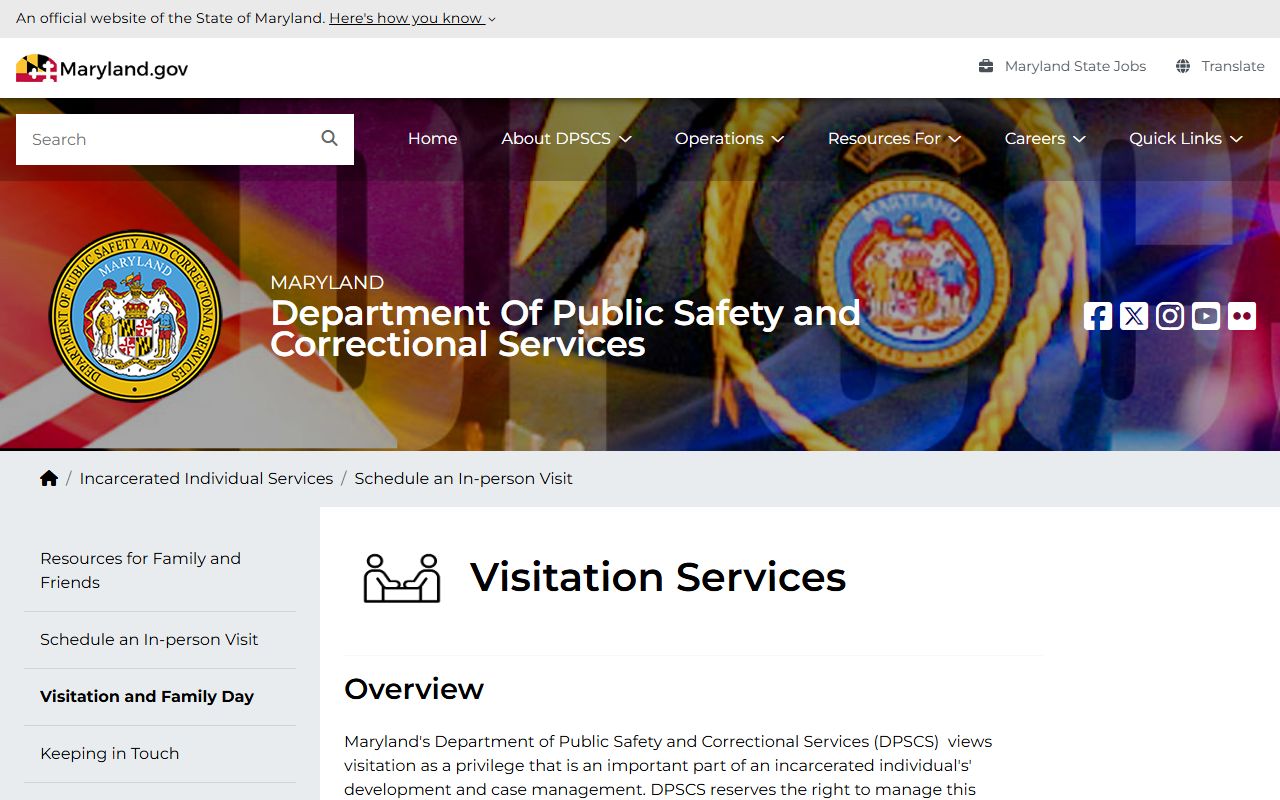
The state's visitation page sets the ground rules for visitors.
The screenshot is from the DPSCS visitation page.
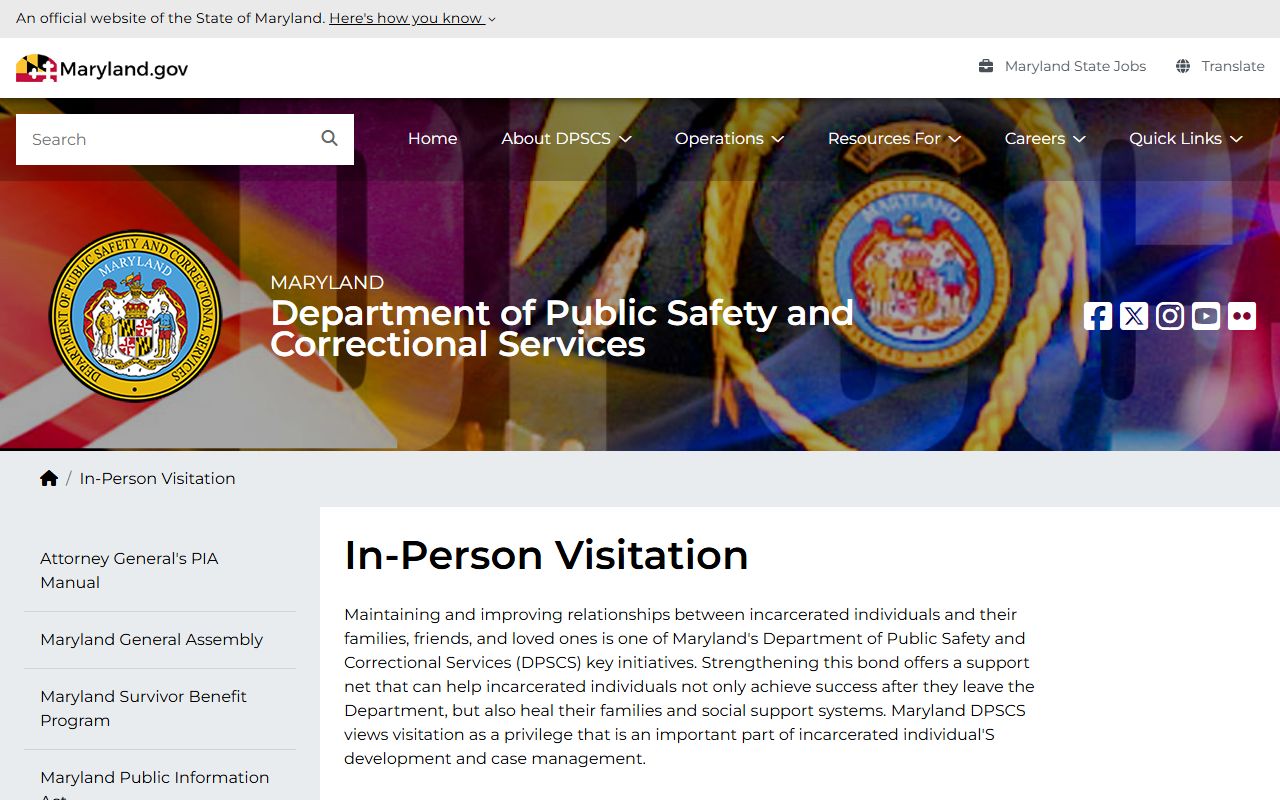
Read it for current rules on dress, conduct, and what you can bring.
The table lists the visit-request email for each Baltimore facility. Send your request to the matching address.
| Facility | Location | Visit Request Email |
|---|---|---|
| BCBIC | Baltimore | BCBIC.InmateVisitation@maryland.gov |
| CDF | Baltimore | CDF.InmateVisitation@maryland.gov |
| MRDCC | Baltimore | MRDCC.InmateVisitation@maryland.gov |
| MTC | Baltimore | MTC.InmateVisitation@maryland.gov |
| YDC | Baltimore | YDC.InmateVisitation@maryland.gov |
The inmate-visitation page gives more detail on how social visits are arranged.
The screenshot is from the DPSCS inmate visitation page.
Always check the state's alerts first, since weather or an emergency can change visiting hours.
Important: Every visitor must clear a metal detector. Clothing with metal can block clearance and lead to a denied visit. Contraband in a place of confinement is a crime under Maryland Criminal Law Article sections 9-410 and 9-412 through 9-417. Banned items include phones and other telecom devices, escape tools, weapons, alcohol, controlled substances, and tobacco. A conviction can carry 3 to 10 years in prison, fines of $1,000 to $5,000, or both.
How to Contact a Baltimore City Inmate
Besides visits, families stay in touch by phone, mail, and money deposits. The state treats family contact as a key part of its work. Phone and money services run through a single vendor account, while mail follows state policy. Each path has its own rules.
Phone calls and money deposits go through ConnectNetwork, the authorized portal for GTL and ViaPath. There are two main account types. An AdvancePay prepaid phone account lets an inmate call a phone number you fund. A ConnectNetwork PIN Debit account puts money on the inmate's own phone debit balance. The state warns that fees may apply to any deposit method, and the exact terms appear when you set up a deposit.
Mail is allowed and encouraged within state policy. Incarcerated people may receive letters, reading material, and publications consistent with the law and DPSCS rules. Scanning, content, and package policies change, so check the current mail-services page before you send anything. Attorney visits are handled apart from social visits and may need bar identification, a set appointment, and a security clearance. Confirm those details with the specific facility.
Baltimore City Inmate Records and the Sex Offender Registry
Some people who leave custody carry registration duties. Maryland keeps a public sex offender registry for registrants who live or work in the state. It is separate from the inmate locator, but it matters for anyone tracking a person after release. The registry lets the public search by name and by area.
The registry runs its own search tool, launched from the registry landing page. A search can return a registrant's photo, the area where they live or work, the offense, and the registration term. Members of the public can also sign up for movement notifications.
The screenshot is from the Maryland Sex Offender Registry.
For release verification and notification tools like VINELink, the released inmates page covers each option in detail.